Early detection: You are entitled to these check-ups
Children and adults with statutory health insurance are entitled to early detection and preventive medical check-ups. An overview of what you get paid by health insurance at what age.

The essentials in brief:
- Statutory health insurance companies pay for regular health checks and early cancer detection examinations.
- Those who take part can collect points for bonus programs.
- The health insurance companies can cover additional extras. In addition, there are early detection examinations as individual health services (IGeL) that have to be paid for out of pocket.
Check-ups for adults
The early detection of certain diseases is an important preventive measure. Anyone who takes them regularly is doing something to maintain health and improve the chances of recovery. The earlier serious illnesses are recognized, the better the possibilities to respond to them medically.
People with statutory health insurance are entitled to a whole series of regular early detection examinations. These depend on gender and age and are granted at different intervals.
- from 18 years to 35 years (women and men): a one-time general check-up
- from the age of 20 (women): once a year a genital examination for the early detection of cancer
- up to 25 years (women): annual test for infection with chlamydia
- from 30 years (women): An annual breast and skin examination is added to cancer screening. Make sure that you are instructed in breast self-examination for regular early detection.
- from 35 years (women): every three years a combined screening of cytological examination and HPV test
- from the age of 35
(women and men): every three years a general health check-up for the
early detection of kidney and cardiovascular diseases and diabetes, for
example.
- As part of the check-up: From autumn 2021 , one-time screening for hepatitis B and hepatitis C virus infection. This is intended to identify undiscovered infections and treat them at an early stage in order to prevent long-term effects. If the last check-up is less than three years ago, the screening can also be carried out separately for a transitional period.
- from the age of 35 (women and men): every two years a skin cancer screening (early detection). The skin of the entire body is examined.
- from 45 years (men): annual cancer screening of the genitals and prostate
- from 50 years (women): early detection of colon cancer - as an annual test for hidden blood in the stool.
- from the age of 50 (men): early detection of colon cancer - at the age of 50 to 54 either as an annual test for hidden blood in the stool or from the age of 50 through two colonoscopies at least ten years apart.
- from 50 to 69 years (women): For the early detection of breast cancer, you will receive an invitation to a mammography screening every two years.
- from 55 years (women): early detection of colon cancer - either every two years as a test for hidden blood in the stool or through two colonoscopies at least ten years apart.
- from the age of 65 (men): one-time entitlement to an ultrasound examination for the early detection of aneurysms in the abdominal artery
Each fund can also provide for further examinations as voluntary services in its statutes. You should clarify this with your health insurance company on a case-by-case basis.
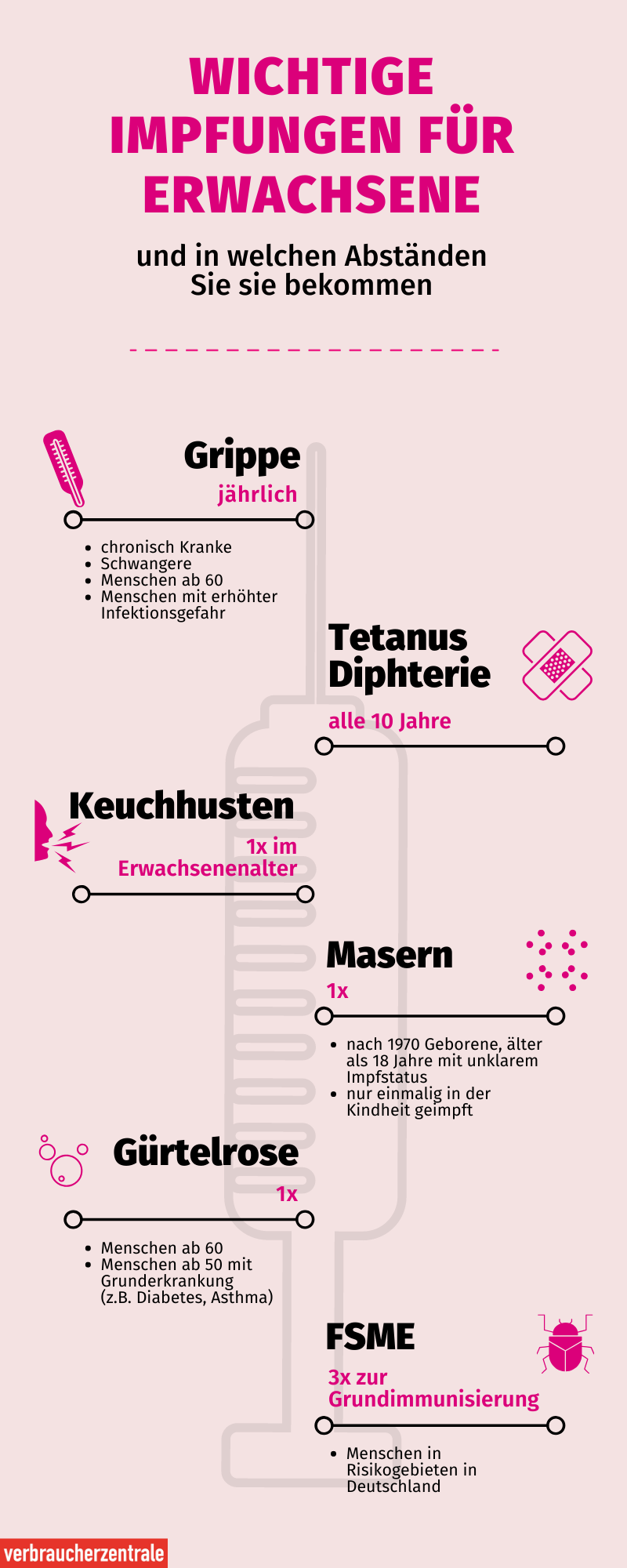
Important vaccinations for adults and how often you get them
In addition, statutory health insurance pays for various vaccinations for men and women of all ages. Long-lasting protection against infections is also part of the preventive services. Statutory health insurance companies cover the costs for all vaccinations recommended by STIKO . However, each insurance fund can provide for further vaccination offers as voluntary services in its statutes. You should clarify this with your health insurance company on a case-by-case basis.
The recommended booster vaccinations include:
- Tetanus (lockjaw) and diphtheria every ten years
- Whooping cough (pertussis) once in adulthood (18 to 60 years)
- Measles once if you were born after 1970, are older than 18 years and have an unclear vaccination status or were only vaccinated against measles once in childhood.
- from the age of 60 one-time vaccination against pneumococci
- Annual flu vaccination for the chronically ill, pregnant women, people over 60 and people with an increased risk of infection, such as medical staff.
- Shingles (herpes zoster) if you are either over the age of 60 or have an underlying condition such as diabetes or asthma and are 50 years of age or older.
- TBE for everyone who is in risk areas within Germany and may come into contact with ticks. You can find out which areas within Germany are among the risk areas in the current information in the Epidemiological Bulletin of the Robert Koch Institute. You can view the 2019 edition here .
Preventive medical check-ups for children and young people
From birth to adulthood, a series of examinations for early detection and prevention are planned at the expense of the health insurance companies. These include:
- In the first six years of life, a total of ten examinations are scheduled in which the sensory, respiratory and digestive organs, skeleton and muscles and congenital metabolic disorders can be examined and possible developmental and behavioral disorders can be identified. These are the so-called U-examinations U1 to U9, including U7a . Several regular vaccinations - including for diphtheria, tetanus, whooping cough, polio, measles, mumps and rubella - complete the preventive care offer for the youngest. After the birth, parents receive an examination booklet in which all important examinations are listed.
- For young people between the ages of 12 and 15 there is another examination to check their physical condition and mental development (youth health examination/J1). You can find detailed information on this on the website of the Joint Federal Committee .
- In addition, the costs of the vaccination against cancer of the cervix (HPV vaccination) for girls aged nine to 14 are covered after a doctor's consultation. The Standing Vaccination Commission (STIKO) recommends vaccination against HPV not only for girls aged 9 to 14, but since June 2018 also for all boys of this age. Adolescents who have not been vaccinated against HPV by the age of 15 should do so as soon as possible and before their 18th birthday.
Bonus program
With bonus programs, health insurance companies try to make regular participation in check-ups palatable to their policyholders. Those who can provide evidence of regular check-ups receive a financial subsidy or other bonuses. Insured persons must register for the bonus program and have their examinations stamped by the doctor.
Bonus booklet at the dentist
If, for example, a denture is due, all insurance companies reward regular check-ups at the dentist with financial subsidies. It is therefore important that the regular check-ups are recorded in the bonus booklet as proof. Normally, health insurance companies only pay half of the costs for standard care for dentures. Anyone who has their teeth checked at least once a year for five years in a row receives a subsidy of 60 percent; Anyone who can prove regular provision with the bonus booklet for ten years will even have 65 percent of the costs reimbursed.
Individual Health Services (IGeL)
In addition, many medical practices also advertise special tests and (preventive) examinations, which they offer against private assumption of costs, since these are not included in the statutory catalog of benefits and the health insurance companies do not cover the costs for them.
These are so-called IGeL services (individual health services). Their usefulness is disputed in many cases. The IGel Monitor evaluates frequently offered examinations based on scientific knowledge. Patients should therefore check additional offers that their insurance company does not pay for before agreeing and consult with their health insurance company to what extent additional treatments that are subject to a fee make sense in individual cases. You should clarify in advance whether the health insurers will bear the costs - because the amounts for services already paid for privately are usually not subsequently reimbursed.
The two most frequently performed IGeL services are intraocular pressure measurement for glaucoma early detection and ovarian ultrasound for early cancer detection . According to the analysis of the IGeL Monitor 2020, these two IGeL services are again at the top. The IGel-Monitor notes that the possible damage outweighs the benefit for both services. Specialist societies and professional associations also advise against these two services.
Posting Komentar untuk "Early detection: You are entitled to these check-ups"